
Your audience is the campaign
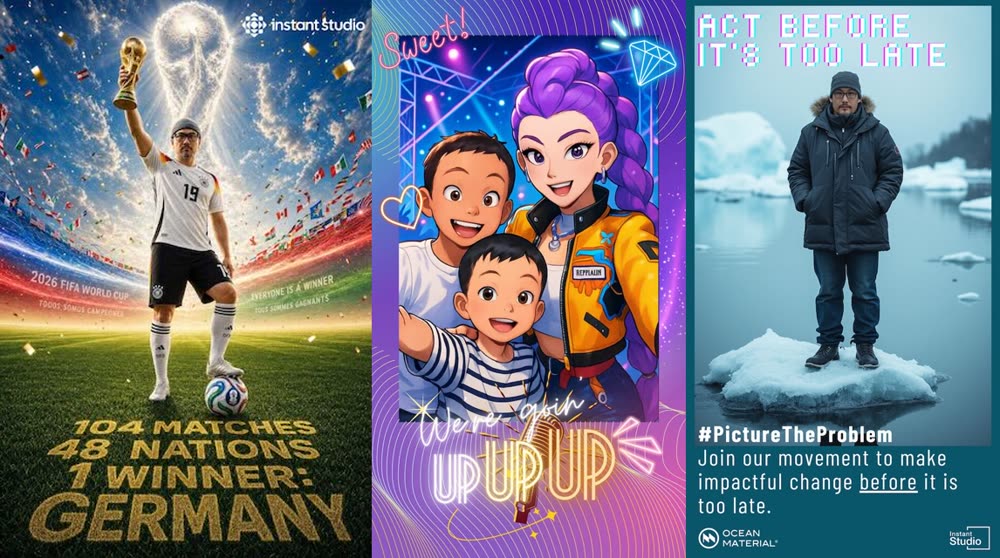
A media buy purchases attention. Instant Studio Campaigns turn that attention into participation.
Each person supplies a photo, makes a few choices and receives a branded image or video made for them. The output gives them a reason to share; the experience gives the brand a direct value exchange through which to collect first-party data.
This is now a product, but it grew out of client work. Sun Life gave more than 20,000 agents a way to create personalised New Year video greetings with the brand's local ambassador and share them with their clients. In a separate campaign, Ocean Material collected email addresses from more than 100 participants after a single Instagram post.
Try the live demos as a participant. The mechanic is easier to understand in ninety seconds on your phone than in a slide deck.
One mechanic, three marketing outcomes
The journey is straightforward: visit, upload, choose, provide an email address, receive the asset, share. There is no app to install and no creation interface to learn.
Within that short journey, the campaign can do three jobs:
- create a one-to-one branded asset at the point of engagement;
- capture a useful first-party identifier in return for that asset; and
- give the participant a reason to carry the campaign into their own network.
Email capture is typically required before the finished image or video is delivered. We can configure it as optional, but the stronger commercial model is a clear exchange: data for something with personal value. The page states how the data will be used, while any permission for future marketing is handled explicitly in the campaign's consent copy.
Why participation changes distribution
Personalisation changes what people are being asked to share. A fan posts an image of themselves lifting the World Cup trophy. A supporter passes on a cause message with themselves inside it. Sharing the campaign becomes an act of self-expression, and the brand travels with it.
Identity, affiliation and self-expression give the participant a reason to distribute the work that a conventional branded asset rarely has. The brand still owns the setting, style and message, but the audience supplies the personal relevance.
Distribution is part of the creative idea, designed in from the start.
Four useful campaign territories
The format works best when it attaches to a moment or community with existing energy:
- Events: extend a launch, exhibition or tournament beyond the venue with something guests create and take away. Try World Cup 2026, then read our World Cup playbook.
- Holidays and festivals: turn a familiar calendar moment into a branded act of participation. Try Songkran.
- Fan communities: give people a credible way to place themselves inside a sport, film or music world they already know. Try the K-pop experience.
- Causes: make an issue feel immediate by connecting the message to the participant's own image. Try Ocean Material.

The brief before the build
The AI can execute the mechanic; it cannot supply the audience insight. A strong brief needs to resolve five things before production begins:
- The moment: why is this relevant now?
- The participant role: who or what does the audience get to become?
- The reward: what will feel worth the effort and the data exchange?
- The share signal: what will make the output expressive, useful or socially valuable?
- The next action: what should the campaign create for the brand beyond the asset itself?
These decisions change the build. A live event needs speed, throughput and an immediate result. A cause campaign may need more narrative context before the upload. A fan campaign depends on whether the transformation feels native to the world the audience already knows. The technology is largely the same across all of these; the participation design has to be rebuilt for each.
Measure the participation funnel
Reach is only the top of the story. The more useful view is the movement from impression to start, start to email submission, email submission to completed creation, and result to share or onward action.
Those conversion points diagnose different problems. Strong traffic with a weak start rate usually points to the proposition. A drop at the email step suggests that the value exchange is not convincing enough. Submissions without completed creations point to friction or slow generation. Healthy completion with limited sharing suggests that the output works as a personal takeaway and has not yet become social currency.
Not every share can be observed once an asset leaves the browser, so reporting should combine measurable actions with campaign-level signals rather than pretend the entire earned effect is attributable. The goal is to understand both what the experience captured directly and what it encouraged the audience to do next.
Brand control before the first upload
A public-facing AI campaign cannot behave like an open prompt box. Before launch, we define the available choices, visual styles, copy and limits on what the system can create. Participants have room to make the result personal, but only inside an experience the brand and its legal or compliance teams can review.
The data journey is designed with the same discipline. The page explains what the participant is providing, what they receive in return and how their information will be used. Uploaded photos are deleted after processing. The experience runs in a browser, avoiding the adoption and permission overhead of a campaign app.
Where to start
A Pilot tests one branded image experience with a limited audience. A Launch provides a complete campaign with email capture and reporting. A Custom build adds what a larger activation may require: video, higher volume, live-event capacity, multiple markets or languages, CRM integration and enterprise support.
The Campaigns pricing page sets out the current scope of each option.